SilverFit contributes to innovative NWO research
How do you ensure that people remain motivated to move, even when exercising requires effort and results are not always immediately visible? That is the central question in the four-year NWO research project “Room for motivation to exercise”, led by Dr Katinka van der Kooij from the Department of Human Movement Sciences at Vrije Universiteit Amsterdam. The project investigates how variation in difficulty levels within movement activities and games can contribute to stronger intrinsic motivation to keep exercising and moving.
For SilverFit, participating in this research is a valuable opportunity to connect scientific insights directly with practice. The project uses several games from the SilverFit 3D, while researchers regularly exchange ideas with colleagues from SilverFit’s Development department to align theory and technology as effectively as possible.
The challenge of long-term motivation
For many people, starting to move is often easier than continuing to do so. This is especially true in rehabilitation, where patients often need to exercise for extended periods to restore or improve functions. Research shows that interactive movement games can help with this. By registering movements, providing feedback and adjusting challenges to the user’s level, these systems can make exercising more engaging.
However, it is not yet fully clear how these challenges should best be offered. Research by Van der Kooij et al. (2021) has shown that, on average, people are most motivated when they experience success about eight out of ten times. But when the difficulty level is continuously fixed at that optimal success rate, a new problem may arise: users may less clearly experience that they are actually improving. Their performance does improve, but because the system keeps adjusting the challenge, the perceived difficulty remains the same. As a result, an important sense of progress may be lost.
Finding the right balance
The research by Van der Kooij and her colleagues therefore focuses on an important follow-up question: how much variation in challenge is needed to keep people optimally motivated?
Perhaps a constant difficulty level is less effective than a system in which challenges are deliberately varied. A task may sometimes be slightly easier, creating experiences of success, while at other times it may be somewhat more difficult, allowing users to notice that they are developing new skills. By investigating different strategies for variable challenge, the researchers hope to better understand which approach leads to sustainable motivation to keep moving.
The ultimate aim is to make movement technology smarter: not only by optimally matching a user’s current level, but also by encouraging them to become and remain more proactive in moving.
The role of SilverFit
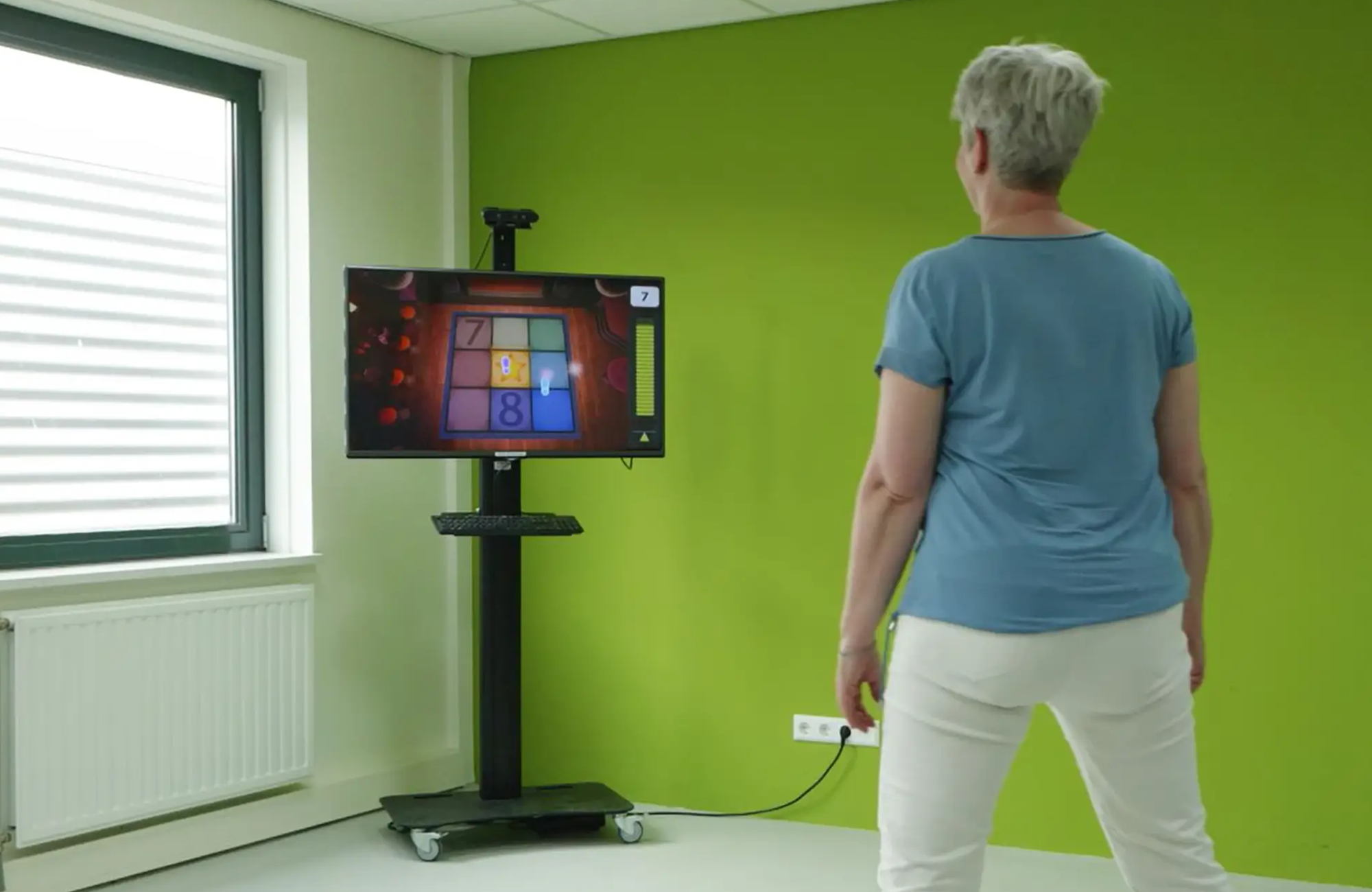
Within this research project, SilverFit makes an important practical contribution. Several games from SilverFit 3D have been made available as standalone versions to test different forms of challenge and feedback. The game The Mole was adapted for this research so that the player can hit only eight out of ten moles in time. Thanks to the combination of movement registration, interactive exercises and game elements, the games provide an excellent environment for investigating new motivation strategies in practice.
In addition, regular consultations take place throughout the project between the researchers and SilverFit’s Development department. This collaboration ensures that scientific insights can quickly be translated into concrete applications within the software and games. At the same time, researchers receive valuable feedback from practice on usability, user experiences and technical possibilities.
This interaction between science and product development is essential. Innovations are not only conceived in the office, but also tested against the daily reality of healthcare professionals and users. This creates a strong foundation for solutions that are both scientifically grounded and practically applicable.
From research to impact
The insights from the project may ultimately be highly meaningful for a wide range of target groups. Although the starting point lies in rehabilitation, the results may also be relevant for older adults, people with chronic conditions and other users of movement technology. Wherever long-term exercising and movement are important, motivation plays a crucial role.
For SilverFit, participating in this research aligns seamlessly with its mission to get people moving in an enjoyable and effective way. By working with scientific partners and actively integrating new knowledge into product development, SilverFit contributes to the future of motivating movement technology.
Over the next four years, the researchers will gradually gain more insight into how variation in challenge influences movement behaviour. This may ultimately lead to movement games that not only train effectively, but also help people stay motivated, especially at the moments when perseverance is most difficult. In doing so, the project’s goal comes closer: sustainably encouraging people to keep moving of their own accord.
References:
Room for exercise motivation with variable challenge | NWO
Two NWO grants for Human Movement Sciences – Vrije Universiteit Amsterdam
Research grant: Room for exercise motivation with variable challenge | Amsterdam UMC
Motivation as a function of success frequency | Springer Nature Link